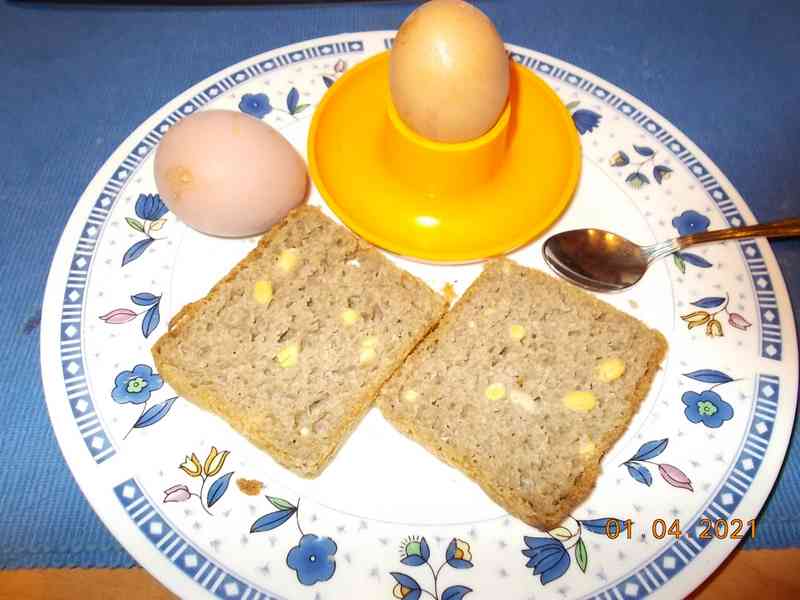
I thought about salted butter and concluded it is harmful
It's salted largely to preserve it. Nowadays there are other preservatives and refrigeration, however in some places people have come to like the taste. The amount of salt in it is actually very small, and there are of course other ways to reduce it from a diet.
a miserable place to live under former Presidency but now they are up for a revival with the new government
Things are on the up for them after the nightmare of trumpet and his republican sociopaths.
I thought the salty taste of that butter was quite conspicuous. But I still remember it from 1980s and the technology of making it might have changed since then.
I'm glad to hear that you've discovered the dangers of salt. It is quite literally a killer. You should try not to take more than 6g per day. You should watch your children's diet too. Research shows that even young children who have a salty diet, have elevated blood pressure for their ages. You'll struggle a bit Paw, because you like many of the traditional Polish dishes which are heavy on the salt and fat. However, it's worth it. It does mean though that you'll pretty much have to cut out the wędliny, sausages, and even the smoked fish in large quantities. At least you prepare quite a lot of your own which means you can control the amount of added salt.
Butter is actually not too bad as Jon says. The amount of salt added to Kerrygold for example is 1.8g per 100g but you don't use that much butter on bread or even on spuds or whatever. If you use it once a day on your toast you'd be ok and good quality butter like the Irish stuff has lots of nutrients and vitamins which are beneficial unlike things like ketchup which are loaded with salt but have no benefits at all.
You can counteract the effects of salt with certain foods. Beetroot is great because it's loaded with potassium which lowers the blood pressure. Fresh beetroot juice every day, or fermented beetroot juice are both ideal. Of course the stuff in the shops has added salt! So make your own. Also extract of olive capsules, 1000mg per day has been shown to lower blood pressure by up to 10 points. You can use it alongside regular blood pressure meds and it helps to keep the dosage of the meds lower. They use it in hospitals in Australia for treatment of blood pressure patients as it's so effective.

edible - if you eat it you won't get very sick and/or die but you might not enjoy it
"Those mushrooms taste liks @ss but they're edible."
eatable - depending on context
you can eat it and it's not bad... but not very good either
"The sandwiches in the snack bar are eatble." (but nothing to write home about)
not haute cuisine but... better than expected
"This improvised casserole I made from three days of leftovers is actually quite eatable."
I wouldn't be surprised if eatable originated as a mispronuncation and/or misspelling from edible since in USEnglish the ends of the words are pronounced the same, only the initial vowel is different...
I wouldn't be surprised if eatable originated as a mispronuncation and/or misspelling from edible
Very probably and undoubtedly it's of American origin. I have never heard any speaker of British English refer to something as 'eatable'.
even made sure in an online dict.
Which suggests that you knew there was something not quite comme il faut about the word :) Eatable is what I would classify as 'a word', as opposed to ' a word' , if you get my drift. It's one of those modernisms that has crept into usage but is definitely not commonly used by speakers of British English. It has a certain inelegance about it.
I think palatable is a better choice of word than eatable, or perhaps tolerable might be more suitable if the taste is just borderline acceptable. Now, a lovely word for something tasty is 'toothsome' - oh how I love the English language :))
Ooops, in this case, we will drop it. If the Queen mother (not Queen Mother) learnt her faithful sons use inelegant expressions, she would be really pissed off.
pretty much, I do think I'm more likely to use eatable in writing than speaking...
a lovely word for something tasty is 'toothsome'
Nope. I don't like it.... I wouldn't use it of food, the only use I would have for it would be as a symonym for 'toothy' as in "a toothsome grin" (the implication being that they are teeth you really don't want to see).
Irish butter is the most expensive one in Germany.
Portuguese butter from the Azores is probably the best I've ever had, incredibly delicious and addictive.
Irish butter is the most expensive one in Germany.
It's pretty expensive in Ireland too! :)) Every blessed thing costs a small fortune in Ireland. I buy Kerrygold in Poland for between 10 and 12 zl for a 200g pack. It's relatively expensive but it's one of the few treats I indulge in. Biedronka have some very acceptable Irish cheddar for a reasonable price. The Kerrygold cheddar costs about double.
Portuguese butter from the Azores is probably the best I've ever had
We had an exchange on that topic a while back. I'd love to taste it and see how it compares to Irish.
In Ireland butter is salted as a matter of course, that's the way we make butter - opposite to Poland :) so it's not that salted butter is expensive, as such. It's just that the cost of living in Ireland is very high. But here in Poland Irish butter is comparatively expensive compared to local ones. However, the flavour and nutritional value of Irish butter is exceptional and it's a little bit of home for me :)
I buy Kerrygold in Poland for between 10 and 12 zl for a 200g pack.
Seems about the going price at the moment. I normally buy Kerrygold in ASDA for £2 per 250g. Not a big fan of salted butter, but Kerrygold (in my store anyway) has only 1.8g per 100g, so basically next to nothing. I don't think it's too expensive compared to some margarines, and others butters in those plastic tubs.
Did this tradition originate coz ancient Irish wanted to prevent butter from going off???
Interestingly (maybe) salted butter is the norm in the US as well (Irish influence? German influence) unsalted butter is available but.... I usually prefer salted.
I was surprised originally how butter in Poland wasn't better, a pretty basic dairy product but for a long time it just wasn't very good.
I was even told a time that margarine was better (compared to the butter of the time... kind of true). I thought maybe it was just me and then I saw an article by Polish food critics complaining about Polish butter. One of the complaints was that manufacturers would improve their products just to improve their market share and then cut back on quality again...
In recent years it's gotten a lot better though Portugal, Ireland and Denmark are my olympic podium.
Butter prices have increased to the point that a lot of European bakers have turned to using margarine in the last few months. The old time Polish bakers have not caved in yet and are still using butter however.
Grandma Reb, who else. Google it if you disagree with her. Polish cuisine primarily uses butter as a key ingredient, rather than margarine as it is considered a signature element in many traditional Polish dishes, including pierogi, potato pancakes and various meat dishes. Butter is used for frying or as a topping rather than margarine.
margarine is more common in traditional Polish baking
That is what I said, commercial bakers have gone to margarine because of the cost increases on butter however the old time at home Polish bakers are still using butter.